

Ask what the UK police uniform looks like and you will get several correct answers at once. Dress varies by force, by role, by rank and by the type of incident an officer is sent to. There is no single national outfit that every constable wears.
That matters if you are preparing for Police Scotland recruitment. You will see photographs, museum pieces and news reports that all show a “British police uniform”, and most of them come from England and Wales. Knowing which is which keeps you accurate in an interview and stops you repeating something that does not apply north of the border.
This guide walks through what the evidence actually shows: historical examples from a regional archive, a documented England-and-Wales redesign, and the formal public order dress codes used at major incidents.
There is no single UK police uniform
Police officers have a job that requires them to be alert and ready for whatever the shift brings. The uniform is part of that readiness. It identifies the officer, it protects them, and it signals authority to the public.
But “the uniform” is a moving target. The Cheshire Police Museum holds uniforms spanning more than a century, including specialist armed police and traffic police examples. BBC News reported a redesign rolled out across England and Wales. His Majesty’s Inspectorate of Constabulary and Fire & Rescue Services (HMICFRS) publishes a public order public safety dress glossary that sets out three different codes of dress.
Those three sources describe three different things. A regional history, a jurisdiction-specific change, and an operational standard tied to incident type. Put them together and the honest answer to “what is the police uniform in the UK?” is that it depends on the force, the date and the job.
One line from HMICFRS makes the point neatly: in code 3, officers wear the standard operational uniform that their own force supplies. The baseline is set locally, not nationally.
Keep England-and-Wales evidence separate from Scotland
The BBC report names the Suffolk force and the Metropolitan Police. It does not mention Police Scotland. The Cheshire archive is a regional English collection. Neither gives a current Police Scotland uniform specification.
So treat those examples as what they are. If you are describing a photograph of a British police officer uniform, caption it by force and date rather than calling it the UK uniform. That habit is useful well beyond uniform trivia: it is the same discipline you need when answering questions about Scottish law and Police Scotland procedure.
A history of police uniforms: the Cheshire timeline
The Cheshire Police Museum collection is one of the clearest records of how British police outfit design changed over time. It holds uniforms, helmets and old photographs from the early days of Cheshire Police, alongside specialist areas such as armed police and traffic police.
The labelled examples run from the mid-nineteenth century through to the 1960s:
- 1857 Cheshire uniform
- 1863 helmet
- 1890 uniform with a shako helmet
- 1900 dress uniform
- 1930 uniform tunic
- 1935 uniform with cap and helmet
- 1950 uniform
- 1964 uniform
That span, 1857 to 1964, shows the pace of change. The 1890 shako helmet sits alongside the 1863 helmet as proof that historical headwear was never limited to one shape. The 1900 dress uniform is a reminder that ceremonial dress uniform and everyday working kit have long been separate things.
Both the Cheshire archive and the BBC connect 1863 with a police helmet. The archive holds the object; the BBC discusses the traditional design in the context of modernisation. Same date, two different kinds of evidence.
The modern operational uniform: tunic, jumper, trousers and high-visibility jacket
In 2002, BBC News reported a new uniform for police officers in England and Wales. The Suffolk force was the first to adopt black trousers, a military style blue jumper and a lightweight high-visibility yellow jacket, scheduled for August of that year.
It replaced the traditional black, silver-buttoned tunic worn by officers at the time. Ranks above superintendent were exempt and stayed in tunics. The BBC noted that the new uniform would eventually be adopted by the other forces in England and Wales.
A Suffolk Police spokesman summed it up:
“The most significant change is the abandonment of the traditional black tunic in favour of a high-visibility yellow coat.”
The stated reasons were comfort and a better fit with the demands of modern policing. That logic has held: the move away from the black tunic towards layered, high-visibility, practical clothing is the single biggest visual shift in the modern British police uniform.
Read it as historical England-and-Wales context, though, not a current UK-wide specification. It tells you why officers stopped looking like Victorian constables. It does not tell you what a Police Scotland officer is issued today.
What “black police uniform” actually means
People often search for the meaning of the black police uniform. The honest answer from the evidence is practical rather than symbolic. The traditional black tunic with silver buttons was the standard working garment for most officers until the 2002 England-and-Wales redesign, and it survived above superintendent rank. Dark clothing with high-visibility layers over the top is now the common operational pattern. The colour carries history, not a formal code.
Why UK police hats differ: helmets, caps and hat bands
Headwear is where the differences show most clearly, which is why so many people ask what the different police hats mean in the UK.
Start with history. The 1863 Cheshire helmet and the 1890 shako helmet are two distinct shapes from the same force within three decades. The BBC describes the traditional police helmet as a 12-inch tall design dating back to 1863.
That design came under pressure. In April of the same year as the uniform redesign, it was announced that police helmets would be made shorter by up to four inches. Officers had criticised the 12-inch design as, in the words reported by BBC News, “too wobbly, falling off too easily and not offering sufficient protection”. Three practical complaints, no ceremony involved.
Hat bands matter too, because they identify role. When the Metropolitan Police unveiled the uniform for its new Community Support Officers, serving officers said the public would struggle to tell the difference between them and real police officers. Metropolitan Police Commissioner Sir John Stevens said he would look at whether the blue and white chequered hat bands worn by CSOs were too similar to those worn by constables. A small detail on a hat was doing serious work: telling the public who had which powers.
Operational headwear is different again. HMICFRS code 2 specifies a police-issued hat, while code 1 specifies NATO helmets. The hat changes with the threat level.
For more on the shapes themselves, including the custodian helmet, see our guide to police hats. Mounted officers are another case entirely, with their own protective headwear and riding kit, covered in our piece on the police horse and mounted section.
Specialist and incident-specific police dress
Here is where “different police uniforms UK” becomes concrete. The HMICFRS glossary entry, published on 9 December 2024, defines the uniform and protective equipment officers should wear for public order public safety incidents. There are three codes of dress.
| Dress code | What officers wear |
|---|---|
| Code 1 | Full personal protective equipment (PPE), fire-resistant overalls and NATO helmets, carrying shields at the direction of the public order public safety commander |
| Code 2 | PPE and a police-issued hat, with high-visibility jackets worn over the PPE; the force must make sure NATO helmets and shields are readily available |
| Code 3 | The standard operational uniform that their own force supplies |
The progression is logical. Code 1 is the highest level of protection: fire-resistant overalls and NATO helmets exist because officers may face missiles and burning material, and shields are deployed on the commander’s call. Code 2 keeps the PPE but swaps the helmet for a police-issued hat and adds high-visibility jackets, so officers stay visible and approachable while remaining protected, with NATO helmets and shields held close by. Code 3 is normal policing in the standard operational uniform.
Understanding that ladder is genuinely useful in a competency-based interview. It shows you grasp that public order policing scales its response, and that personal protective equipment is a tactical decision tied to public safety rather than a fixed outfit.
Specialist roles add another layer. The Cheshire collection identifies armed police and traffic police as distinct specialist areas with their own uniform history. Those roles have always looked different from a patrol constable, and they still do.
What equipment is worn with a UK police uniform
The British police officer uniform is more than the clothing. It includes the kit carried on it.

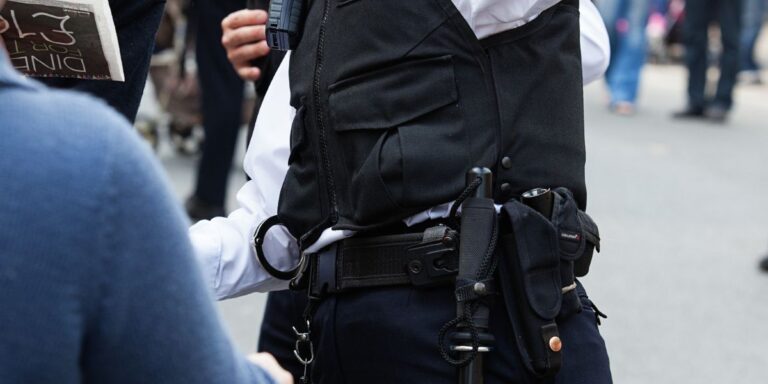
Everyday carry items such as handcuffs and the police baton are mounted on a belt or, increasingly, on a vest-mounted carry system that spreads the load across the torso. Our breakdown of what police carry on their belts goes through the standard items.
For public order deployments, the kit list is set by the dress code rather than personal preference. Code 1 brings full PPE, fire-resistant overalls, NATO helmets and shields. Code 2 keeps PPE and adds a high-visibility jacket over it. Code 3 reverts to the force’s standard operational uniform.
Note that high-visibility clothing appears in two separate contexts. The BBC’s England-and-Wales example included a lightweight high-visibility yellow jacket as part of everyday dress, while HMICFRS mentions high-visibility jackets specifically for code 2 public order deployments. Same garment type, different purposes. Do not collapse them into one universal kit list.
How force and role affect what the public sees
Three named examples appear in the evidence: Cheshire Police, the Suffolk force and the Metropolitan Police. Each illustrates a different variable.
Cheshire shows variation over time, with a regional archive running from 1857 to 1964. Suffolk shows variation by force and rollout, as the first England-and-Wales force to take on the new black trousers, blue jumper and high-visibility jacket. The Metropolitan Police shows variation by role, through the CSO hat band question and the need to distinguish Community Support Officers from constables.
That last point is the one most worth remembering. A London police officer uniform and a CSO uniform in the same borough were close enough in appearance to prompt a commissioner-level review. Role identification is a design requirement, not a detail.
Plain-clothes detectives and CID: what can be stated safely
Detective dress is a common question and it deserves a careful answer rather than a confident wrong one.
The available evidence covers uniformed officers, ranks, helmets, Community Support Officers, specialist armed and traffic policing, and public order dress codes. None of it sets out a UK-wide rule for CID or detective clothing, including a universal business-attire requirement.
What can be said is that detective work and uniformed patrol are different jobs with different visibility needs, and that force policy governs dress. If you want the practical picture, read our articles on why police detectives wear suits and how to become a detective in Scotland.
The point for applicants: avoid blanket claims. Saying “all detectives wear suits” or “detectives never wear uniform” will not survive scrutiny from an interviewer who has worked in CID.
Reading a Police Scotland comparison properly
If you are preparing for Police Scotland, apply three habits when you look at uniform information.
Label the jurisdiction. The 2002 BBC report concerns England and Wales. It names Suffolk and the Metropolitan Police. It is not a Scottish source and should never be quoted as one.
Keep force policy central. HMICFRS ties code 3 to the standard operational uniform supplied by the officer’s own force. Even within a shared framework, the baseline kit comes from the force.
Do not convert history into current guidance. The Cheshire page is a historical regional archive covering 1857 to 1964. It tells you how the British police uniform evolved. It tells you nothing about what is issued today.
Get those three right and you will describe UK police uniforms accurately, without overclaiming. That precision is exactly the quality assessors look for.
Frequently Asked Questions
Why do UK police have different hats?
Because headwear reflects date, force, role and operational context rather than one national standard. The Cheshire archive holds an 1863 helmet and an 1890 shako helmet. BBC News discusses a 12-inch traditional helmet, a shorter redesign and the hat bands worn by Metropolitan Police Community Support Officers. HMICFRS code 1 calls for NATO helmets, while code 2 specifies a police-issued hat.
Can I buy a police uniform?
The available uniform evidence does not cover this. It documents a museum collection of historical uniforms and operational dress codes, but gives no purchasing or legal guidance for civilians. Do not assume permission from uniform sources alone; check the legal position before buying or wearing anything resembling police dress.
What are the different police forces in the UK?
Three forces appear as examples here: Cheshire Police, the Suffolk force and the Metropolitan Police. They are illustrations, not a complete directory. The material focuses on uniform history, one England-and-Wales rollout and public order dress codes rather than a list of UK forces.
When did UK police stop wearing tunics?
There is no single UK-wide date. BBC News describes an England-and-Wales rollout in which Suffolk was the first force to adopt a new uniform, with the traditional tunic retained by ranks above superintendent and eventual adoption by other forces in England and Wales. That is England-and-Wales evidence and should not be presented as a Police Scotland date.
What is the police uniform in the UK?
There is no single design. The examples include Cheshire historical tunics, helmets and dress uniform; an England-and-Wales combination of black trousers, a military style blue jumper and a high-visibility yellow jacket; and HMICFRS public order codes that add PPE, NATO helmets, shields or high-visibility jackets depending on the code.
Why are UK cops called bobbies?
The uniform sources used here do not explain the nickname. They cover historical clothing, modern uniform changes and public order dress codes. The origin of the term is not something these sources can settle.
Does the UK have metro police?
The Metropolitan Police exists as a named force, including its Community Support Officers, but there is no nationwide category called “metro police”. Use the force’s formal name when describing a uniform rather than treating the phrase as a UK-wide force type.
Are there different types of police in the UK?
Yes. The evidence distinguishes regular officers from Metropolitan Police Community Support Officers and identifies specialist areas such as armed police and traffic police. It also describes different public order dress codes. These examples are not a complete classification of every UK policing role.
What equipment do police officers need?
It depends on the context. HMICFRS lists full PPE, fire-resistant overalls, NATO helmets and shields for code 1; PPE, a police-issued hat and a high-visibility jacket for code 2; and the force’s standard operational uniform for code 3. BBC News separately describes a lightweight high-visibility yellow jacket in its England-and-Wales example.
Do UK police detectives wear uniforms?
There is no UK-wide answer in the available evidence. It covers uniformed officers, Community Support Officers, specialist roles and public order dress, but not detective attire. Avoid claiming that every detective either always wears or never wears a uniform.
Next step
Uniform knowledge is useful background, not a test subject in itself. What actually decides your application is the Police Scotland Entrance Test, the fitness assessment and the interview. If you can explain why public order dress scales from code 3 to code 1, you already have the right instinct: understand the reasoning, not just the label.
Put that instinct to work on the part of the process that counts. Start with a realistic practice run at https://www.jointhecops.co.uk/free-pset/ and find out where you stand before you apply.
Sources
Realistic mock exams in Language, Numeracy and Information Handling with complete explanations.
What Do Police Carry on Their Belts in the UK

The meaning of blue lights on Police Cars
